
Regression analysis is an instance of supervised learning. The goal is to estimate the dependent variable  by using the independent variable
  .
.
Variables
- : independent variable, features
- : dependent variable, response
 : (unknown) noise or error
 : a function of
  : Parameter or weight vector of the function
Model

Goal
Predict the value corresponding to  that is outside the training set. Find a function that fits the dataset
Approach
- We have access to the dataset , which is the training set with
 . In theory, we want to find the optimal function
  , in practice, we can only estimate the function with the estimate
  .
. - We assume lies under some hypothesis class
 of all available functions.
 - We assume that the set of is parameterized with parameter vector .
- Example (all functions are linear):

- We now can reduce the optimization problem to the problem of estimating
- can be learned from the examples or data set

- Find an estimated parameter
 that minimizes the cost function
Optimization
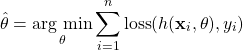
Regression analysis models
- Linear regression
- Ridge regression
- Logistic regression
Neueste Kommentare